In the design department of a medium-sized mechanical engineering firm, at pump or compressor manufacturers, or in the agricultural sector, there is often a sense of helplessness when only five or ten castings are needed for a new development or an urgent replacement part. The conventional supply chain for castings is primarily designed for high-volume production. When small quantities are requested, unit costs rise to uneconomical levels due to the necessary model-making. Design engineers face the challenge of choosing a process that strikes a balance between technical precision, time savings, and reasonable initial costs. This guide analyzes the technological options for small quantities and shows which method makes production cost-effective.
The choice of process determines the project’s return on investment and timeline. Castfast offers a digital marketplace that provides access to a broad network of specialized foundries. Based on the component data, the system identifies which partner and which process best meet the technical requirements.
Take advantage of Castfast’s technical expertise for your project. Upload your CAD data and receive an informed assessment of the optimal manufacturing method for your small-batch production.
Traditional sand casting begins in the model shop. A physical model made of wood or plastic replicates the geometry and creates the impression in the molding sand. The cost of this model-making is fixed and is incurred regardless of the eventual production run. For small production runs, this investment is spread across just a few parts, which means that the fixed costs per component often exceed the actual material cost.
In addition, model building takes time. Wait times of several weeks delay the project schedule. If testing reveals that the geometry needs to be adjusted, this requires either modifying or rebuilding the model. Flexibility is limited once the tool physically exists. This poses a risk for procurement, as changes to the design result in high follow-up costs.
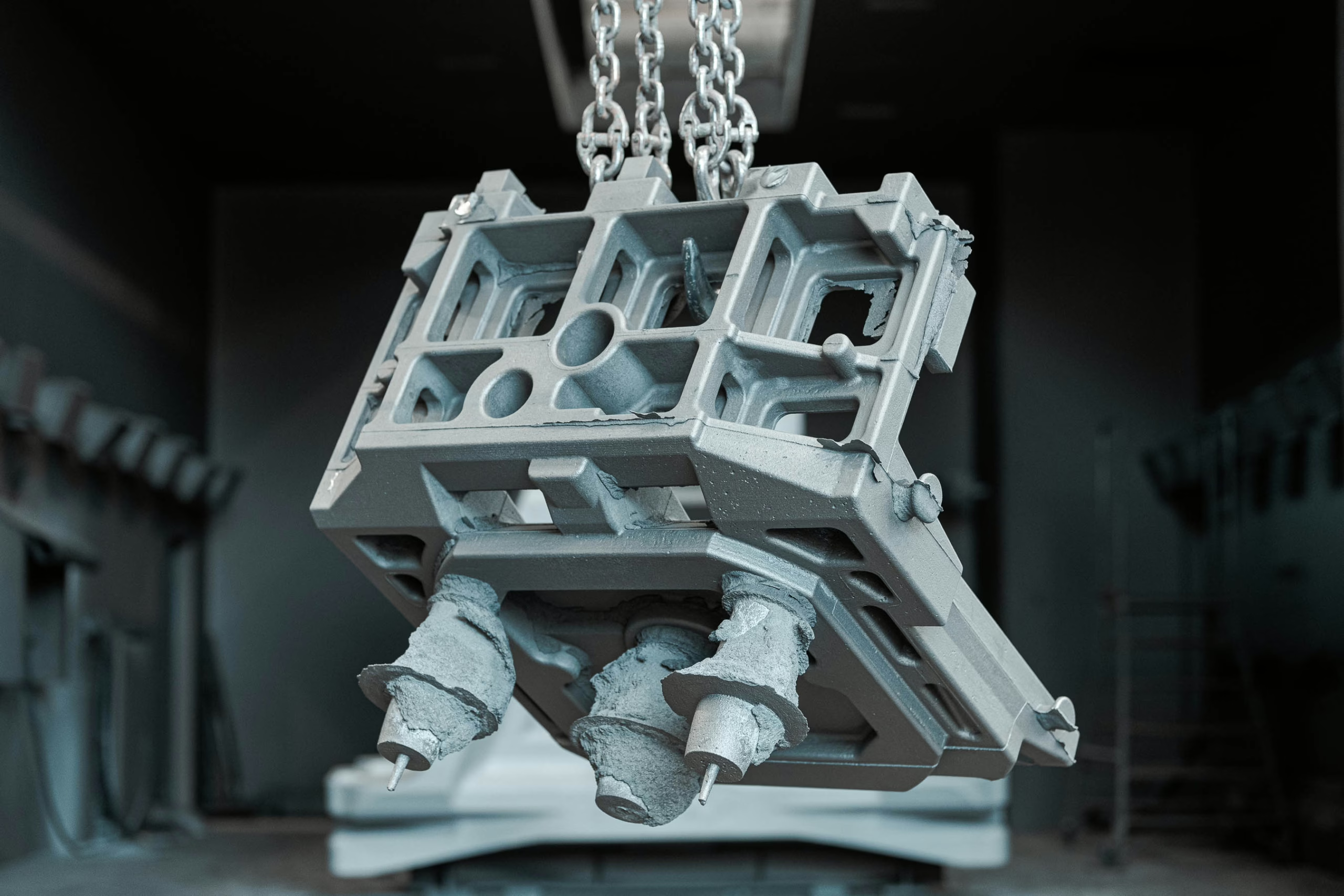
3D sand casting uses CAD data to build the mold layer by layer from quartz sand and a binder. A physical model is no longer required. This process offers design freedom, as the mold no longer needs to be removed. Complex undercuts are no longer a design consideration, which reduces component weight and improves functionality. Design engineers can incorporate cooling channels or complex internal geometries directly into the casting without having to plan for complex core assemblies.
The quantity ranges from 1 to 20 units, which eliminates the need for tooling costs.
The component geometry is complex and would require time-consuming core assemblies.
The schedule does not allow for months of lead time for model building.
These are replacement parts for old systems for which no physical models exist anymore.
During the prototyping phase, design changes are still expected, which will be implemented entirely digitally.
Since there are no tooling costs, production costs can be accurately estimated starting with the very first part. Castfast uses this process to reduce lead times for complex components to just a few weeks. The physical properties of the finished part are comparable to those of conventionally cast parts.
Once demand goes beyond the prototype phase and production volumes reach around 20 units, the cost-effectiveness changes. Once a model has been created, it can be used for numerous castings. The cost per additional part decreases because the casting process is faster than the layer-by-layer build-up in a 3D printer.
The material properties are no different from those of the printed counterpart. Both the 3D-printed and conventional processes involve casting gray iron, ductile iron, or aluminum. Differences are evident in the surface finish, although a well-maintained plastic model often yields smoother surfaces in its as-cast state.
The order quantity exceeds 20 units, so the cost of the model will pay for itself.
The geometry is kept simple and does not require complex cores.
The component is intended for long-term series production, with small batches being ordered on a regular basis.
The component size exceeds the capabilities of standard 3D printers.
Choosing the traditional approach requires a final design, since any subsequent changes to the model will incur additional costs. Castfast provides an impartial assessment of the point at which switching from 3D printing to model building makes financial sense.

When components require a very high surface finish and dimensional accuracy, investment casting is the technically superior choice. In this process, a wax model is created and coated with a layer of ceramic. After the wax is melted out, an extremely precise mold remains. For small production runs, Castfast uses modern methods such as 3D printing of the wax models. This allows the advantages of investment casting to be leveraged without having to build expensive injection molding tools for the wax parts.
This process is suitable for components that would be too coarse if produced by sand casting or that would require very labor-intensive mechanical finishing. If the precise casting eliminates the need for certain steps on the milling machine, investment casting is often the more economical solution in terms of overall cost, despite higher process costs.
To fully understand the field of small-batch production, it is necessary to examine two additional technologies. Die casting uses permanent steel molds. However, the tooling costs are so high that this process is almost never cost-effective for typical small-batch production in mechanical engineering. It is the method of choice for medium to large production runs, once the quantity reaches the thousands. Castfast advises customers on this matter to help them avoid misguided investments in expensive permanent molds when the design is not yet fully developed.
At the other end of the spectrum is direct metal 3D printing (SLM/DMLS). In this process, the metal powder is fused directly using a laser. This method is suitable for very small parts with extreme requirements (e.g., aerospace or medical technology). For general mechanical engineering, however, it is usually too expensive. The alternative approach—using a printed sand mold and conventional casting—offers a better price-performance ratio while allowing for a free choice of materials, ranging from aluminum to gray cast iron, ductile iron, and steel.

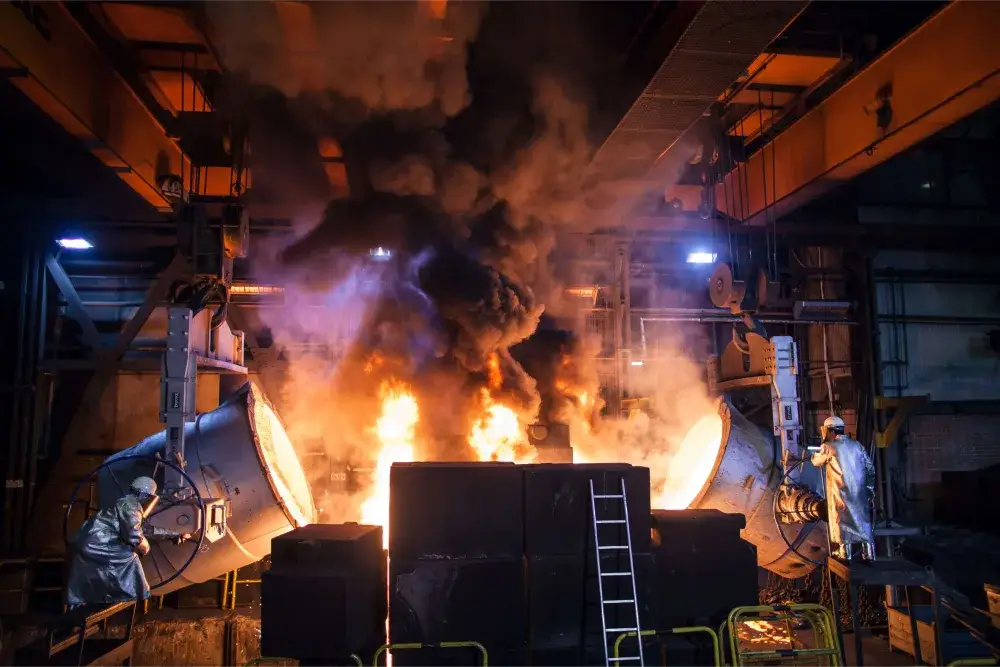
The mechanical properties depend on the flow of the molten metal and the solidification process. A component made of ductile iron achieves a similar strength in a printed mold as it does in a hand-molded one. Since sand dissipates heat slowly, the components cool evenly, which reduces stress. However, expertise in the placement of feeders remains necessary to avoid internal voids.
The choice of material affects costs. Gray cast iron offers good casting properties at low prices. Cast steel requires higher temperatures and specialized molding techniques. Aluminum allows for lightweight construction but requires precise temperature control. In addition, almost every cast part requires machining of its functional surfaces.
Reliance on individual suppliers poses a risk. Castfast addresses this risk through a network of many partners. Since the molds used in 3D sand casting are based on digital data, they can be produced at different locations with nearly identical or comparable quality. If one facility is operating at full capacity, another partner takes over the order.
Secure your supply chain and optimize procurement costs for small-batch production. Castfast combines technical engineering with a high-performance foundry network to ensure your success.

3D sand printing is cost-effective for batch sizes ranging from 1 to about 20 units. Since there are no costs for physical models made of wood or plastic, the price per component remains consistently low even for very small quantities. For geometrically complex components that would require time-consuming core assemblies using conventional methods, the cost-effectiveness of the printing process can extend to production runs of up to 50 units.
The material quality is identical. Since both processes are based on the sand casting principle, the same molten metal is poured into the molds. Strength, hardness, and chemical composition comply with the applicable DIN and EN standards for cast iron, steel, or aluminum castings. The physical properties of the components depend primarily on the flow of the molten metal and the solidification process, not on the method used to produce the mold.
The lead time is reduced by about four to eight weeks because the model-making step is eliminated. While traditional sand casting requires the initial production of physical models and core boxes, production in 3D sand printing begins immediately after the technical review of the CAD data. This enables the delivery of the first castings within a few weeks.
In 3D sand casting, changes are made directly to the digital data set. Each new shape is printed based on the updated CAD file, eliminating the costs associated with modifying physical models. In contrast, traditional casting requires manual adjustments or the construction of new wooden models for every geometric change, which is time-consuming and expensive.
A network provides redundancy by giving access to various partner foundries that meet identical technical standards. If one facility experiences capacity constraints or goes offline, the order is transferred to another foundry in the network without any delay. Since production data is available digitally, quality remains consistent at every location. This guarantees supply security for small and medium-sized enterprises, even in volatile market conditions.



